Forex for beginners explained as a full course or a paid mentorship which is better for a first account
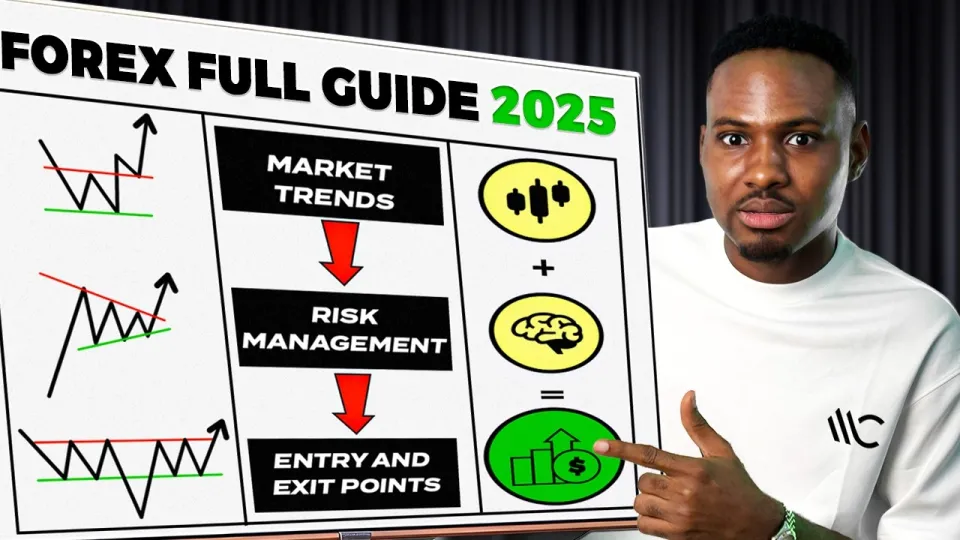
Video: How To Start Forex Trading For Beginners’ 2025 (Full Course)
You can order the same kind of articles for your own video to boost it on YouTube and Google. Just message the Telegram bot @sat_sit_bot. The bot writes and publishes the articles itself (with your YouTube video embedded) on popular topical websites (no ads). Try it free: 50 articles on us.
· based on the channel Jeffrey Benson Forex
Forex for beginners is best started with a free structured full course plus a demo account, because the fundamentals — what currency pairs are, how sessions and leverage work, how to size risk — are freely available and can be learned before any money is at stake; a paid mentorship only makes sense after that base is built and the beginner knows which specific gap they are paying to close. The full-course format used by Jeffrey Benson Forex, with student plans at firepipsfx.com/plans, is a useful benchmark for what a complete beginner curriculum should contain.
What forex trading actually is and why beginners start there
Forex is the market where national currencies are exchanged in pairs, and every quote tells you how much of one currency is needed to buy one unit of another. When a trader buys EUR/USD, they are buying euros and selling dollars at the same time; the profit or loss comes from the change in the exchange rate, not from owning a physical currency. This is why the market is described as a relative-value market: there is no single price of "money", only ratios between two currencies.
Three properties make forex attractive to newcomers and dangerous at the same time:
- Size. Daily turnover in the foreign exchange market runs in the trillions of dollars, which is far larger than any single stock exchange, so major pairs absorb large orders without wild gaps.
- Hours. The market runs 24 hours a day, five days a week, moving between financial centres as they open and close.
- Leverage. Brokers let a small deposit control a much larger position, which multiplies both gains and losses and is the single most common reason beginner accounts blow up.
Most retail volume sits in a handful of majors — EUR/USD, GBP/USD, USD/JPY, USD/CHF, AUD/USD and USD/CAD — because they have the tightest spreads and the most consistent liquidity. Exotic pairs such as USD/TRY or USD/ZAR can move hundreds of pips on a headline and are not a sensible first market.
How the market clock and the four sessions shape a beginner's day
The forex day is divided into four overlapping sessions — Sydney, Tokyo, London and New York — and each one has its own character in terms of volatility and spread width. Sydney opens the week and is the quietest; Tokyo brings the yen pairs to life; London is the heaviest session by volume; New York overlaps with London for a few hours and produces the most tradable movement in EUR/USD and GBP/USD. The London–New York overlap is where most beginner strategies are tested, because spreads are tightest and ranges expand.
A practical consequence for someone with a job: pick one two-to-three-hour window that matches your schedule and study only that window for a month. Traders who chase every session usually end up with no data on any of them. Session awareness also explains why a strategy that works at 9 a.m. London time can fail at 10 p.m. — the same chart pattern means something different when liquidity is thin.
The tools every beginner needs before placing a trade
The minimum toolkit is smaller than most course sales pages suggest: a regulated broker account, a trading platform, a chart with a couple of indicators, an economic calendar and a journal. Everything else is optional until the basics are automatic.
The standard stack looks like this:
- Broker. Regulated, with segregated client funds, spreads disclosed up front and a demo account that mirrors live conditions. The course description points to Assex Markets registration at https://my.assexmarkets.com/auth/register?partner_code=1699134 as the recommended broker for the copy-trade workflow.
- Platform. MetaTrader 5 (MT5) is the reference point: it handles forex, metals and indices, supports one-click trading, and stores the trade history you will need for review. MT4 remains common but is older.
- Charts. A clean candlestick chart on two timeframes is enough — a higher timeframe for direction and a lower one for entry.
- Economic calendar. Rate decisions, inflation prints and employment data move currencies more than any pattern; knowing when they land prevents accidental exposure.
- Journal. A spreadsheet with date, pair, session, setup, risk, result and a one-line reason. This is the cheapest performance tool available.
Copy-trade signal channels are a separate tool, not a replacement for the above. A daily free signal — the course links one at https://t.me/firepipsignals — can show how a professional frames an entry, but copying without understanding the stop placement teaches nothing about risk.
Risk management as arithmetic rather than intuition
Risk management is the part of forex that can be calculated exactly, which is why it is the fastest skill for a beginner to acquire. The rule is simple: decide the maximum loss per trade in money, then let position size follow from the stop distance.
Worked example on a $1,000 account with a 1% risk ceiling:
- Maximum loss per trade = $10.
- Stop-loss distance on EUR/USD = 20 pips.
- Pip value on a standard lot is about $10, so 20 pips on one lot equals $200 — ten times the limit.
- Therefore the position is 0.10 lots (one mini lot), where 20 pips equals roughly $20 — still too much, so 0.05 lots gives about $10.
Two more numbers belong next to that calculation: a maximum daily loss (often 2–3%) and a maximum number of trades per day. Traders who report finally understanding risk management after years of study usually mean exactly this — that position size is derived, not guessed. Leverage of 1:500 does not force a large position; it only permits one, and the stop distance is what determines the size.
A basic strategy foundation and the first trade
A beginner strategy needs three decisions and nothing more: direction, entry and exit. Direction comes from the higher timeframe — for example, price above a rising 50-period moving average on the four-hour chart suggests buying dips rather than selling rallies. Entry comes from a repeatable trigger on the lower timeframe, such as a break of the previous session high or a pullback into a support zone. Exit is two numbers fixed before the order is sent: a stop-loss and a take-profit.
Placing the first trade on a demo account follows a fixed sequence: select the pair, set the order type (market or pending), enter the lot size calculated from the risk rule, attach the stop-loss and take-profit in the order ticket, then confirm. After the trade closes, the journal entry is written the same day, while the reasoning is still fresh. A common beginner target is 30–50 logged demo trades before any live capital is committed; that sample is large enough to show whether the edge exists or whether the results are noise.
Common beginner mistakes and the doubts they create
The mistakes that cost beginners the most money are behavioural, not analytical, and they repeat across almost every account that fails. Overtrading after a loss, moving a stop-loss to avoid taking it, increasing lot size to recover a drawdown and trading through major news without a plan account for the majority of blown accounts. A related error is learning passively: watching hours of tutorials without writing anything down, so the four sessions and the risk formula are forgotten within a week.
The doubts beginners voice most often are about timing and legitimacy. People ask whether it is too late to start, whether a free course can really be enough, and how long it takes before results appear. The honest answers: the market's size means there is no "late"; a free course covers the same fundamentals as most paid introductions, with mentorship paying for feedback rather than information; and a realistic horizon for consistent demo results is measured in months, not weeks. Anyone promising a fixed date for becoming a millionaire is selling hope, not a method.
Useful links
- Student plans and course access: https://firepipsfx.com/plans
- Free daily signal channel: https://t.me/firepipsignals
- Broker registration used in the course: https://my.assexmarkets.com/auth/register?partner_code=1699134
- Premium signal group entry point: https://t.me/jeffreybenzhelpbot
Final takeaway
Forex for beginners is a learnable skill with a fixed core: understand the pair, respect the session clock, size every position from a written risk limit and log the results. A free full course is the right first step because it delivers that core at no cost, and the Jeffrey Benson Forex breakdown is a solid example of how the material should be sequenced — market basics, tools, strategy, first trade, mistakes. Pay for mentorship only when a specific, named gap remains after a few months of demo trading, and treat copy signals as illustrations of process rather than a substitute for it. Start with the free material, then review the student options at firepipsfx.com/plans once the demo journal shows what you actually need.
Key takeaways
- A free full course covers the same core blocks as most paid intros: what forex is, how the market works, tools, strategy, first trade and mistakes.
- Beginners need four things before risking money: a broker account, MetaTrader 5, a demo period and a written risk rule per trade.
- The four sessions — Sydney, Tokyo, London and New York — set liquidity; London–New York overlap is the busiest window for major pairs.
- Risk per trade is a number, not a feeling: a common beginner ceiling is 1% of account equity, so a $500 account risks about $5.
- Jeffrey Benson Forex structures the beginner path as a course plus copy-trade signal channels, with student plans at firepipsfx.com/plans.
Source: How To Start Forex Trading For Beginners’ 2025 (Full Course) · Markdown version
Questions & answers
Can a complete beginner learn forex from a free full course?
Yes. The fundamentals — currency pairs, sessions, leverage, position sizing and a simple entry-and-exit framework — are freely available and identical in substance to most paid introductions. What a paid programme adds is feedback on your own trades and accountability, which matters only after you have a demo journal to review.
How much money do I need to start forex trading?
Many brokers open accounts from $10–$100, but the useful question is position sizing, not the minimum deposit. With a 1% risk rule, a $500 account risks about $5 per trade, which limits you to micro lots and slow progress. A common practical starting range is $500–$2,000 on a regulated broker after a few months of demo trading.
How long does it take before forex trading becomes profitable?
There is no fixed date, and anyone giving one is guessing. A realistic path is several weeks of study, 30–50 logged demo trades, then a small live account run with strict risk limits for a few months. Consistency is judged on a sample of at least 50–100 trades, not on a good week.
Is copy trading from signal channels a good way to start?
It can be a useful teaching tool if you study why the entry, stop and target were chosen, but copying blindly transfers the risk without the understanding. Use free signals to compare against your own analysis, and never increase position size on a copied trade beyond the risk rule you set for yourself.